

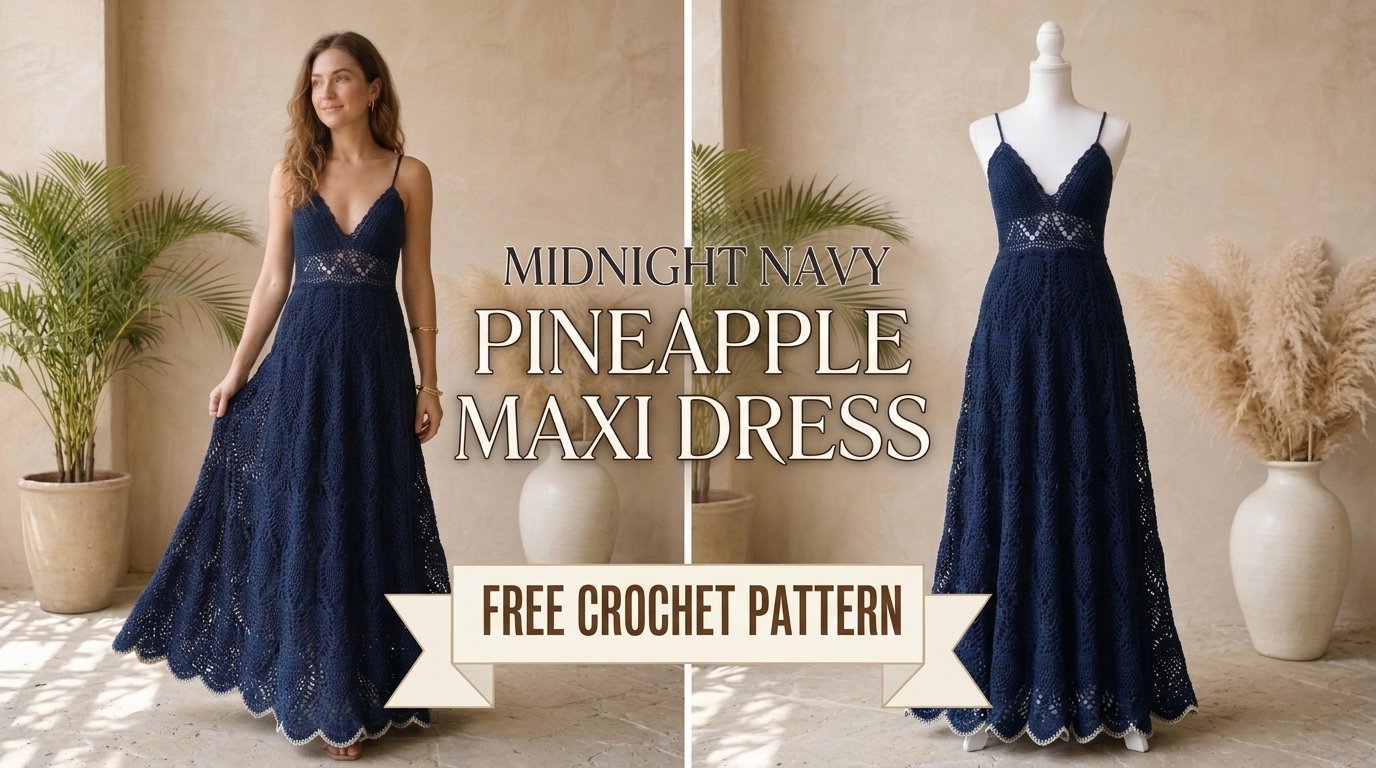
I still remember the exact moment this dress began. It was late one evening, the windows open to a cool breeze, and a single skein of deep navy cotton sitting on my desk under the lamp. I had been flipping through old lace books, the kind with doilies and tablecloths that feel almost too delicate for modern life, when the pineapple motifs suddenly felt different. Soft, open, and somehow strong. I wondered what would happen if those same motifs grew longer, if they wrapped around a body instead of a table, if they moved when someone walked.
That night I started sketching. A simple bodice that would sit close without clinging, then a skirt that opened into cascading pineapples, each one a little larger than the last. The color had to be midnight navy—not bright, not black, but that particular inky blue that looks almost black in shadow and reveals its true depth in sunlight. By the time the first pineapple was complete on my hook, I already knew the dress would be called the Midnight Navy Pineapple Maxi.
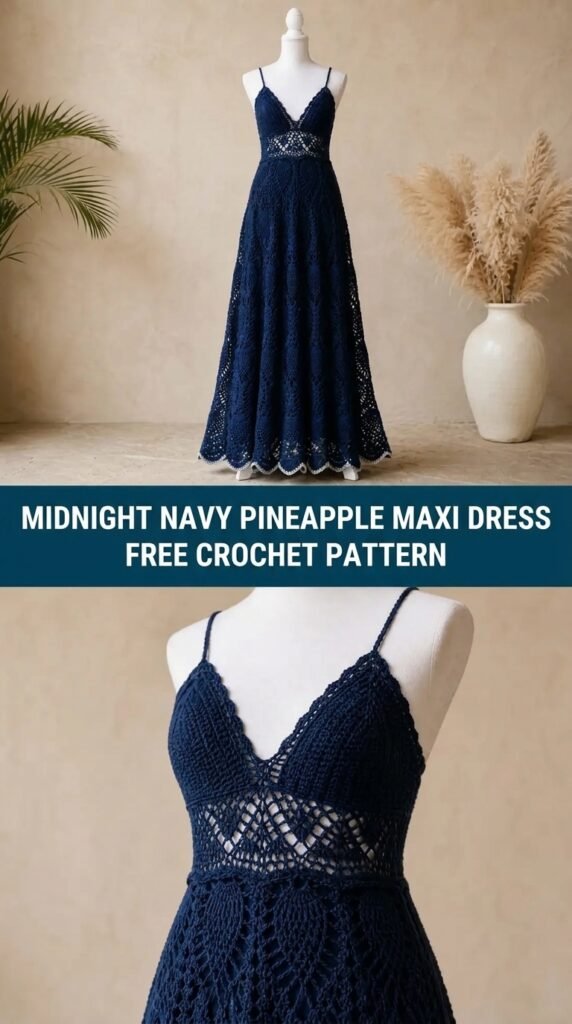
This free pattern is the result of that quiet evening and many more hours of testing, frogging, and refining. It is an intermediate lace design with a fitted upper body and a full, flowing skirt of classic pineapple motifs. The finished piece feels special without being fussy, the kind of dress you reach for when you want to feel put-together yet completely yourself.
About This Pattern
The Midnight Navy Pineapple Maxi Dress is worked from the top down in one piece. The bodice is shaped with simple increases and short rows for a gentle waist, then the skirt expands into repeating pineapple panels that create beautiful movement and drape. The neckline is a soft scoop, the armholes are clean and sleeveless, and the hem falls just above the ankle on most wearers.
This is an intermediate pattern. You should already be comfortable with double crochet, treble crochet, and reading lace charts or written lace instructions. The pineapple motifs themselves are not difficult once the rhythm clicks, but counting and keeping track of the open spaces requires attention. Finished sizes range from S to XL with approximate bust measurements of 34–36″ (S), 38–40″ (M), 42–44″ (L), and 46–48″ (XL). The skirt length is designed to be maxi on a 5′6″ frame; instructions for lengthening or shortening are included.
The fabric has excellent drape thanks to the open lace and the recommended cotton blend. It is not a stiff garment. Expect it to move with you and to benefit greatly from blocking.
Materials You’ll Need
Yarn
- Color A (Midnight Navy): approximately 1,650 (1,850, 2,100, 2,350) yards / 1,510 (1,690, 1,920, 2,150) meters of DK-weight cotton or cotton-blend yarn (Category 3).
Suggested: a smooth mercerized cotton or a cotton-bamboo blend for soft sheen and good stitch definition.
Allow 15 % extra for gauge variation and personal length preference.
Hooks
- 3.5 mm (E) hook for the bodice and upper skirt transitions
- 4.0 mm (G) hook for the main pineapple skirt (the larger hook softens the lace and improves drape)
Notions
- Tapestry needle
- Stitch markers (at least 8)
- Blocking mats and pins (or rust-proof T-pins)
- Optional: small clear beads for the tip of each pineapple if you like a subtle sparkle
Abbreviations and Terminology
All instructions use US crochet terminology.
- ch – chain
- sc – single crochet (insert hook, yarn over, pull up loop, yarn over, pull through both loops)
- hdc – half double crochet (yarn over, insert hook, yarn over, pull up loop, yarn over, pull through all three loops)
- dc – double crochet (yarn over, insert hook, yarn over, pull up loop, yarn over, pull through two loops, yarn over, pull through remaining two)
- tr – treble crochet (yarn over twice, insert hook, yarn over, pull up loop, [yarn over, pull through two loops] three times)
- dtr – double treble crochet (yarn over three times, insert hook, yarn over, pull up loop, [yarn over, pull through two loops] four times)
- sl st – slip stitch
- sp – space
- sk – skip
- rep – repeat
- beg – beginning
- RS – right side
- WS – wrong side
Turning chains do not count as a stitch unless a step explicitly says they do. When a pineapple begins or ends with a chain space, the chain space is always counted as part of the motif.
Gauge
Work a gauge swatch in the pineapple stitch pattern using the 4.0 mm hook:
Chain 40.
Work Rows 1–12 of the Basic Pineapple Motif (given below under Special Techniques).
Blocked swatch should measure approximately 4½″ wide by 4″ tall for the 12-row section.
If your swatch is smaller, go up a hook size for the skirt. If larger, go down a half size. The bodice is worked more firmly with the 3.5 mm hook and should measure 4″ across 18 dc.
Main Pattern Instructions
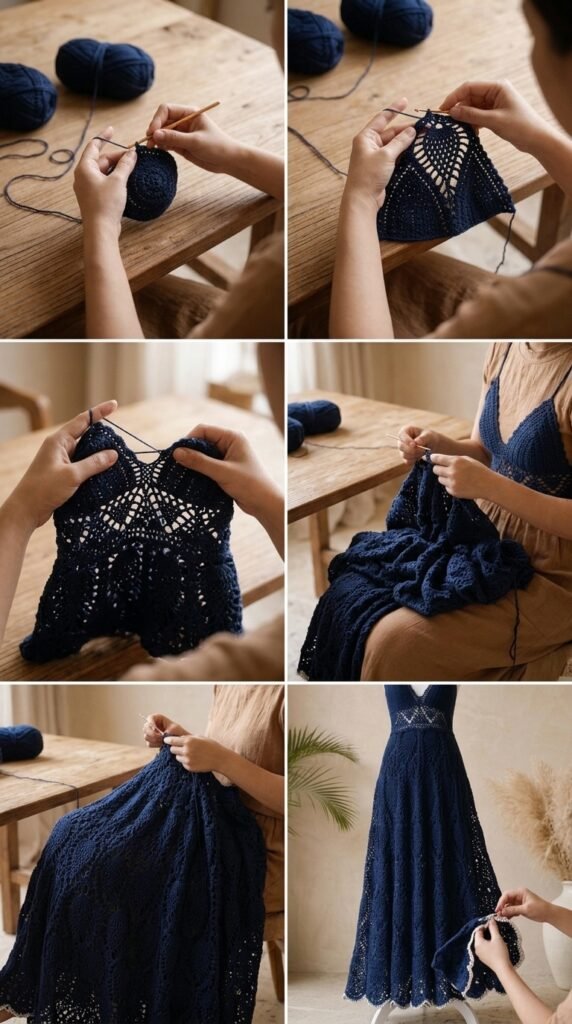
Bodice
All sizes begin the same way.
With 3.5 mm hook and Color A, ch 120 (132, 144, 156). Being careful not to twist, join with sl st to first ch to form a ring.
Round 1 (RS): Ch 2 (does not count as st), dc in each ch around, join with sl st to first dc.
Count: 120 (132, 144, 156) dc.
Round 2: Ch 2, dc in each dc around, join.
Repeat Round 2 until the piece measures 3½ (3½, 4, 4)″ from the foundation chain.
Shape armholes
Next Round: Ch 2, dc in next 28 (31, 34, 37) sts, ch 8 for underarm, sk next 32 (34, 36, 38) sts, dc in next 28 (31, 34, 37) sts, ch 8 for underarm, sk remaining 32 (34, 36, 38) sts, join to first dc.
Count: 56 (62, 68, 74) dc + 2 ch-8 underarms.
Next Round: Ch 2, dc in each dc and each ch of the underarm chains around, join.
Count: 72 (78, 84, 90) dc.
Continue even in dc rounds until the bodice measures 7 (7½, 8, 8½)″ from the foundation chain, or desired length to the underbust.
Waist shaping (optional but recommended)
Decrease Round: Ch 2, *dc in next 10 sts, dc2tog; rep from * around, adjusting the last few stitches as needed so the total decreases evenly.
Work 1 more even round, then work a second decrease round if you prefer a more defined waist.
Final waist count should be approximately 60 (66, 72, 78) dc. Mark the beginning of the round with a stitch marker; this becomes the center back.
Transition to Skirt
Change to 4.0 mm hook.
Setup Round: Ch 1, sc in each dc around, placing 4 (4, 6, 6) evenly spaced increases (2 sc in the same stitch) so the total stitch count becomes a multiple of 12.
Count: 72 (72, 84, 84) sc for the first two sizes, 96 (96) sc for the larger sizes. (Exact multiples of 12 make the pineapple placement clean.)
Pineapple Skirt
The skirt is built from repeating pineapple panels. Each panel is 12 stitches wide at the base and expands outward.
Basic Pineapple Motif (worked in the round, RS always facing)
Round 1: Ch 3 (counts as dc here and throughout the motif section), dc in next 2 sc, *ch 3, sk 3 sc, (dc, ch 3, dc) in next sc, ch 3, sk 3 sc, dc in next 3 sc; rep from * around, ending last repeat with dc in last 3 sc, join to top of beg ch-3.
Round 2: Ch 3, dc in next 2 dc, *ch 2, 7 dc in next ch-3 sp (this is the base of the pineapple), ch 2, dc in next 3 dc; rep from * around, join.
Round 3: Ch 3, dc in next 2 dc, *ch 2, dc in next dc, [ch 1, dc in next dc] 6 times, ch 2, dc in next 3 dc; rep from * around, join.
Round 4: Ch 3, dc in next 2 dc, *ch 2, sc in next dc, [ch 3, sc in next dc] 6 times, ch 2, dc in next 3 dc; rep from * around, join.
Round 5: Ch 3, dc in next 2 dc, *ch 3, sk next ch-2, sc in next ch-3 sp, [ch 3, sc in next ch-3 sp] 5 times, ch 3, sk next ch-2, dc in next 3 dc; rep from * around, join.
Round 6: Ch 3, dc in next 2 dc, *ch 3, sk first ch-3, sc in next ch-3 sp, [ch 3, sc in next ch-3 sp] 4 times, ch 3, sk last ch-3, dc in next 3 dc; rep from * around, join.
Round 7: Ch 3, dc in next 2 dc, *ch 3, sk first ch-3, sc in next ch-3 sp, [ch 3, sc in next ch-3 sp] 3 times, ch 3, sk last ch-3, dc in next 3 dc; rep from * around, join.
Round 8: Ch 3, dc in next 2 dc, *ch 3, sk first ch-3, sc in next ch-3 sp, [ch 3, sc in next ch-3 sp] twice, ch 3, sk last ch-3, dc in next 3 dc; rep from * around, join.
Round 9: Ch 3, dc in next 2 dc, *ch 3, sk first ch-3, sc in next ch-3 sp, ch 3, sc in next ch-3 sp, ch 3, sk last ch-3, dc in next 3 dc; rep from * around, join.
Round 10: Ch 3, dc in next 2 dc, *ch 4, sk first ch-3, sc in next ch-3 sp, ch 4, sk last ch-3, dc in next 3 dc; rep from * around, join.
Round 11 (increase / expansion round): Ch 3, dc in next 2 dc, *ch 5, sk the ch-4 and sc, (dc, ch 3, dc) in the center of the next group of 3 dc (this starts the next pineapple), ch 5, dc in next 3 dc; rep from * around, join.
Repeat Rounds 2–11 for the desired length, working additional expansion rounds every 10–12 rows so the skirt gradually flares. For a true maxi length on a 5′6″ frame, work approximately 9–11 full pineapple sequences after the setup.
Size note: Larger sizes begin with more panels (8 panels for S/M, 10 panels for L/XL). The expansion rate remains the same; simply keep the same number of panels throughout.
When the skirt reaches approximately 2″ short of desired finished length, work one final sequence ending on Round 10, then finish with a simple edging.
Hem Edging
Edging Round 1: Ch 1, sc evenly around the entire lower edge, working 3 sc in each large ch-space and 1 sc in each dc or sc of the pineapples. Join.
Edging Round 2: Ch 1, *sc in next sc, ch 3, sk 1 sc; rep from * around, join. Fasten off.
Special Techniques
Starting a new pineapple after expansion
When Round 11 places a (dc, ch 3, dc) between existing panels, treat that new (dc, ch 3, dc) exactly as the beginning of a fresh pineapple on the next round. The surrounding chain spaces simply grow longer to accommodate the extra width.
Keeping count
Place a removable stitch marker in the center dc of each group of 3 dc that sits between pineapples. Move the markers up every few rounds. This makes it easy to see where each motif begins and ends.
Optional beaded tips
If using beads, slide one small bead onto the yarn before working the final sc at the tip of each completed pineapple on Round 10. Secure the bead with the sc.
Assembly and Finishing
Because the dress is worked in one piece, there is almost no seaming. Weave in all ends carefully on the wrong side, paying special attention to the underarm chains and any color joins (there should be none if you used a single color).
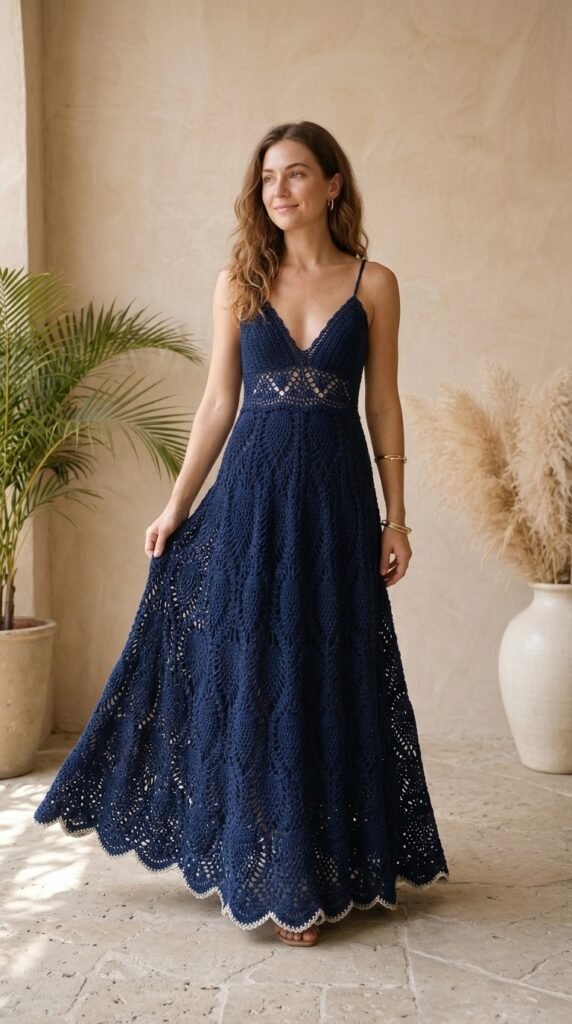
If the neckline feels too wide or the armholes too deep after blocking, you may work a single round of sc around the neck and armholes to firm them slightly. Do this before the final block.
Blocking and Care
Wet-block the finished dress for the best results. Soak in lukewarm water with a mild wool wash for 15–20 minutes. Gently squeeze out excess water (do not wring). Lay flat on blocking mats and pin the pineapples open so each motif shows its full shape. Pin the hem into a gentle curve and the bodice to the desired measurements. Allow to dry completely.
Care: Hand wash in cool water, roll in a towel to remove moisture, and dry flat. Never hang a wet lace dress; the weight of the water can stretch the pineapples permanently. Store folded or rolled rather than on a hanger for long periods.
Fit and Troubleshooting Tips
- If the bodice feels tight across the bust, go up one hook size for the entire upper section or add a few extra stitches at the underarms.
- If the pineapples look cupped or closed, you are likely working the chain spaces too tightly. Relax your tension on the chains or go up half a hook size for the skirt only.
- If the skirt flares too quickly, reduce the number of expansion rounds. If it hangs too straight, add one extra expansion sequence.
- For a shorter midi version, stop after 5–6 pineapple sequences and work the edging.
- Heavy cotton can make the dress stretch slightly with wear. Blocking to the exact measurements you want helps control this.
FAQ’s
Is this pattern suitable for beginners?
This is written as an intermediate pattern. You should already be comfortable with double crochet, treble crochet, working in the round, and following multi-row lace repeats. Absolute beginners may find the pineapple counting and expansion rounds frustrating. If you are an advanced beginner who has successfully completed a few lace shawls or doilies, you can likely manage it with patience and stitch markers.
Can I use a different yarn weight?
The pattern is designed for DK-weight (Category 3) cotton or cotton-blend. Sport weight will create a finer, more delicate fabric and will require more yardage and possibly a smaller hook. Worsted weight will produce a heavier, less drapey dress and will change the finished size significantly. If you substitute, make a full pineapple gauge swatch and adjust the number of starting stitches accordingly.
How do I adjust the length?
For a shorter midi or tea-length dress, simply work fewer pineapple sequences (5–7 full sequences instead of 9–11). For a longer maxi or for taller wearers, add 1–2 extra sequences before the final edging. Always measure the skirt against your body or a dress form after blocking a section so you can stop at the right point.
What if my stitch count is off in the middle of a pineapple?
Stop and count the chains and stitches in the current motif. Most errors happen when a chain space is accidentally skipped or worked twice. Place markers in the center of each “3-dc group” between pineapples and move them up every few rounds. This makes it much easier to spot and correct mistakes early.
Can I make this dress in multiple colors?
Yes. You can change colors at the beginning of any round. Many makers enjoy working the bodice in one shade of navy and the pineapple skirt in a slightly lighter or deeper tone. Carry the yarn loosely up the inside or fasten off and weave in ends carefully so the color changes stay neat.
How much does the dress stretch with wear?
Cotton and cotton-blend yarns have moderate stretch, especially in open lace. Wet-blocking to the exact measurements you want and drying the garment flat helps set the size. Avoid hanging the finished dress for long periods, as the weight of the fabric can gradually lengthen the pineapples.
Do I need a lining?
The lace is open, so the dress is semi-sheer. Many people wear it over a slip, a matching camisole and skirt, or a lightweight maxi slip in a coordinating color. If you prefer full coverage without a separate underlayer, you can crochet a simple sleeveless slip in a matching or contrasting solid yarn and sew it in at the underarms and waist.
Can I sell items made from this pattern?
Yes. You may sell finished dresses made from this free pattern. Please credit the pattern name and designer when possible. Do not sell or redistribute the written pattern itself.
Final Thoughts
There is something quietly magical about finishing the last pineapple and watching the dress take its full shape on the blocking mats. The navy deepens, the lace opens, and suddenly the piece that began as a late-night sketch becomes something you can step into and feel transformed by.
I hope this Midnight Navy Pineapple Maxi Dress brings you the same sense of calm focus I felt while designing it. Wear it to a summer evening, a wedding, or simply because the light looks beautiful through the lace. When you finish yours, I would love to see it—leave a comment, tag your photos, or pin it so others can find the pattern too.
Happy crocheting. May every stitch feel purposeful and every pineapple open just right.


Leave a Reply
You must be logged in to post a comment.