


I still remember the exact afternoon the idea for this dress took root. I was sitting on the porch with a cup of iced tea, watching the sky shift through every shade of coral, peach, and soft gold as the sun dropped toward the horizon. The light was so warm it almost felt like it had texture. I wanted to catch that feeling in yarn — something light enough to move with the breeze, soft enough to wear against the skin on a warm evening, and delicate enough that the flowers would seem to float.
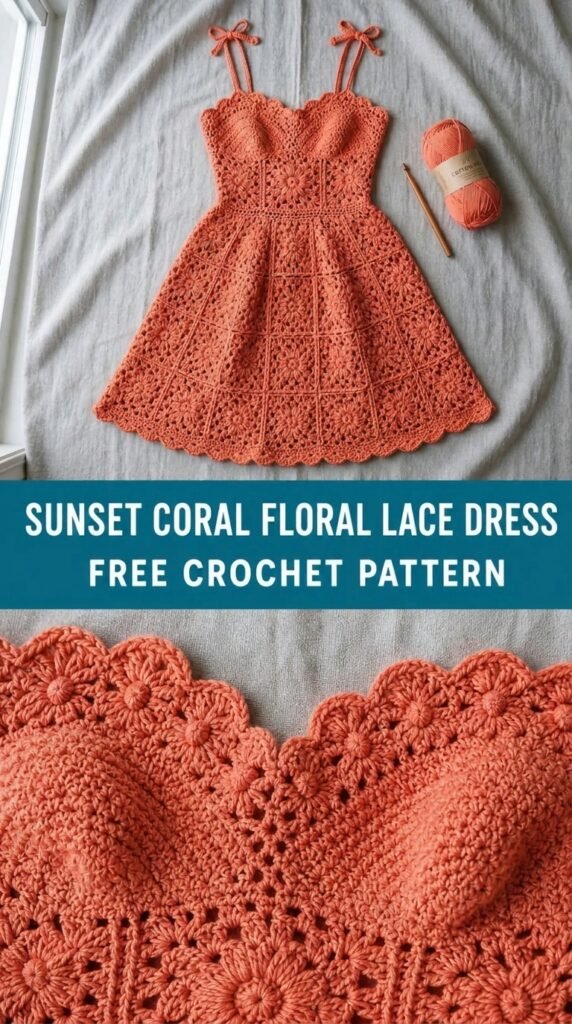
I started sketching floral motifs that evening and kept refining them for weeks until the petals opened just right and the connecting lace felt airy instead of fussy. The result is the Sunset Coral Floral Lace Dress. It is a sleeveless midi-length dress built from joined floral motifs for the bodice and a flowing lace skirt that echoes the same petal shapes. The colorway is intentionally soft and glowing — think sun-warmed coral melting into peach and pale apricot. It is the kind of dress you reach for when you want to feel a little romantic without trying too hard.
About This Pattern
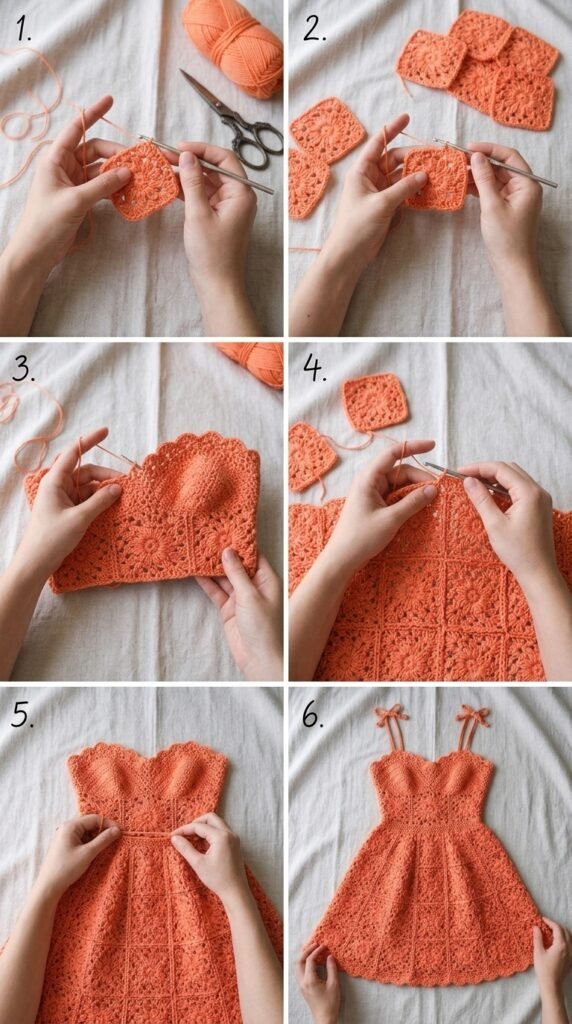
This is an intermediate pattern. You should already be comfortable reading charts or written lace instructions, working motifs, joining as you go or seaming, and managing yarn tails. The construction begins with individual floral motifs that are joined into a fitted bodice. The skirt is then worked downward from the lower edge of the bodice in a repeating lace pattern that grows gently outward. The neckline and armholes are finished with a simple picot edging.
Finished measurements (after blocking):
- Bust: 34 (38, 42) inches / 86 (96.5, 106.5) cm
- Length from shoulder to hem: approximately 40–42 inches / 102–107 cm
- Designed with 2–4 inches of positive ease at the bust for comfortable movement and soft drape.
The fabric has beautiful drape once blocked. Expect the lace to open and the motifs to settle into soft, rounded petals. It is not a stiff or structured dress; it moves with you.
Materials You’ll Need
Yarn
I used a light fingering-weight cotton-blend yarn that holds lace well and has a gentle sheen.
- Color A (main coral): approximately 980 (1100, 1250) yards / 900 (1000, 1140) meters
- Color B (peach transition): approximately 220 (250, 280) yards / 200 (230, 255) meters
- Color C (soft apricot highlight): approximately 120 (140, 160) yards / 110 (130, 145) meters
Allow 15% extra for gauge variation and swatching. A gradient cake that moves from deep coral through peach into soft apricot also works beautifully if you prefer fewer ends.
Hooks
- 3.5 mm (E/4) for motifs and bodice
- 3.75 mm (F/5) for the skirt if you prefer a slightly more open fabric (optional)
- 3.25 mm (D/3) for the picot edging if you want a firmer finish
Notions
- Tapestry needle
- Stitch markers (at least 8)
- Blocking mats and rust-proof pins or blocking wires
- Optional: small clear beads for the flower centers (size 6/0 or 8/0)
Abbreviations and Terminology
All instructions use US crochet terminology.
- ch – chain
- sc – single crochet (insert hook, yarn over, pull up loop, yarn over, pull through both loops)
- hdc – half double crochet (yarn over, insert hook, yarn over, pull up loop, yarn over, pull through all three loops)
- dc – double crochet (yarn over, insert hook, yarn over, pull up loop, yarn over, pull through two loops, yarn over, pull through remaining two loops)
- tr – treble crochet (yarn over twice, insert hook, yarn over, pull up loop, [yarn over, pull through two loops] three times)
- dtr – double treble crochet (yarn over three times, insert hook, yarn over, pull up loop, [yarn over, pull through two loops] four times)
- sl st – slip stitch
- sp – space
- sk – skip
- rep – repeat
- beg – beginning
- RS – right side
- WS – wrong side
Special stitches:
- Picot – ch 3, sl st into the first of those three chains.
- Cluster – (yarn over, insert hook, yarn over, pull up loop, yarn over, pull through two loops) three times in the same stitch or space, yarn over, pull through all four loops on hook.
- Shell – (2 dc, ch 2, 2 dc) in the same stitch or space.
- Petal – (dc, ch 1, dc, ch 1, dc) in the same space.
Turning chains do not count as a stitch unless a step explicitly says they do. When joining motifs, the joining slip stitches replace the usual chain spaces so the fabric stays flat.
Gauge
Work one full floral motif and block it flat.
Blocked motif should measure approximately 4 inches / 10 cm across from petal tip to opposite petal tip.
If your motif is smaller, go up a hook size. If it is larger, go down a hook size. Motif size directly affects the finished bust measurement, so take the time to get this right. Make a second motif after adjusting if needed.
Main Pattern Instructions
Floral Motif (make 18 for size S, 20 for size M, 22 for size L)
With Color A and 3.5 mm hook:
Round 1: Make a magic ring. Ch 3 (counts as dc), 11 dc into ring. Join with sl st to top of beg ch-3. (12 dc)
Round 2: Ch 1, sc in same stitch, *ch 3, sk next dc, sc in next dc; rep from * around, ending with ch 3, join with sl st to first sc. (6 ch-3 spaces)
Round 3: Sl st into first ch-3 space, ch 3 (counts as dc), (dc, ch 1, 2 dc) in same space, *ch 1, (2 dc, ch 1, 2 dc) in next ch-3 space; rep from * around, ch 1, join with sl st to top of beg ch-3. (6 shells)
Round 4: Sl st into first ch-1 space of shell, ch 1, sc in same space, *ch 5, sc in next ch-1 space, ch 3, sc in next ch-1 space; rep from * around, ending with ch 3, join with sl st to first sc. (6 large petal arches and 6 small spaces)
Round 5 (petal round): Sl st into first ch-5 space, ch 3, (2 dc, ch 2, 3 dc) in same space (first petal made), *sc in next ch-3 space, (3 dc, ch 2, 3 dc) in next ch-5 space; rep from * around, ending with sc in last ch-3 space, join with sl st to top of beg ch-3. Fasten off Color A.
Round 6 (optional Color B or C accent): Join Color B or C with a standing sc in any ch-2 petal tip, *ch 4, sc in next sc between petals, ch 4, sc in next ch-2 petal tip; rep from * around, join with sl st to first sc. Fasten off.
Weave in ends as you go. Block each motif before joining so the petals open evenly.
Joining the Bodice Motifs
Arrange the motifs into two front panels and two back panels according to size:
- Size S: 4 motifs across the front, 4 across the back, plus 2 for each side underarm panel (total 18)
- Size M: 5 front, 5 back, 2 each side (total 20)
- Size L: 5 front, 5 back, 3 each side (total 22)
Join motifs with a flat slip-stitch seam or by working a continuous join-as-you-go method through the outer chains of Round 6. Leave the top edges of the front and back panels open for the neckline and the outer side edges open for armholes. The lower edge of the assembled bodice should form a continuous circle of petal tips and chain spaces ready for the skirt.
Bodice Upper Edge and Straps
With Color A and 3.5 mm hook, join yarn at the side of the neckline edge.
Work one round of sc evenly around the entire neckline and armhole openings, placing approximately 3 sc in each petal tip and 2 sc in each connecting space. Do not join; continue working in rows or rounds as preferred for your preferred neckline depth.
For simple straps: at the front shoulder points, ch 35–40 (adjust for desired strap length), skip across to the corresponding back shoulder point, and continue the sc round. On the next round, work sc into each strap chain. Repeat for the second strap. Fasten off.
Skirt
Join Color A at the center back of the lower bodice edge with RS facing.
Setup Round: Ch 3 (counts as dc), work 2 dc in the same petal tip, *ch 1, 3 dc in next petal tip or space; rep from * around the entire lower edge of the bodice. Join with sl st to top of beg ch-3. Place a marker at the beginning of the round and move it up each round.
The number of 3-dc groups should be a multiple of 6 for the lace pattern to repeat evenly. Adjust by adding or removing a few dc if needed.
Lace Pattern Repeat (worked in continuous rounds):
Round 1: Ch 3, dc in next 2 dc, *ch 2, sk next ch-1 space, dc in next 3 dc; rep from * around, ending with ch 2, join with sl st to top of beg ch-3.
Round 2: Ch 3, dc in next 2 dc, *ch 3, sk next ch-2 space, dc in next 3 dc; rep from * around, join.
Round 3: Ch 3, dc in next 2 dc, *ch 1, (dc, ch 1, dc) in next ch-3 space, ch 1, dc in next 3 dc; rep from * around, join.
Round 4: Ch 3, dc in next 2 dc, *ch 2, sk next ch-1, sc in next ch-1 space (the center of the V), ch 2, sk next ch-1, dc in next 3 dc; rep from * around, join.
Round 5: Ch 3, dc in next 2 dc, *ch 3, sk next ch-2 and sc and ch-2, dc in next 3 dc; rep from * around, join.
Repeat Rounds 2–5 for the desired length, increasing the number of chain spaces gradually every 8–10 rounds by working an extra ch in two or three evenly spaced locations to create gentle A-line flare. Change to Color B when approximately two-thirds of the skirt length is reached, then to Color C for the final 4–6 rounds if using the three-color sequence.
When the skirt reaches approximately 24–26 inches / 61–66 cm from the underarm (or your preferred midi length), work one final round of sc evenly around, placing a picot every 5th or 6th stitch for a delicate hem.
Special Techniques / Additional Elements
Optional Beaded Centers
Before fastening off Round 1 of each motif, thread a small bead onto the yarn and work the final slip stitch through the bead. This gives the flower centers a soft sparkle that catches the light.
Surface Slip-Stitch Veining (optional)
With Color C and a smaller hook, work surface slip stitches from the center of selected motifs outward along the petal edges to emphasize the floral shape. Keep the tension loose so the fabric does not pucker.
Assembly and Finishing
Because the motifs are joined as the bodice is built and the skirt is worked directly from the lower edge, there is very little seaming. Weave in all remaining ends securely on the wrong side. Check that the straps sit comfortably and adjust length if necessary before the final blocking.

If you prefer a more structured neckline, you may add a second round of sc or a round of reverse single crochet (crab stitch) around the neckline and armholes.
Blocking and Care
Wet-block the finished dress. Soak in lukewarm water with a mild wool wash for 15–20 minutes. Gently squeeze out excess water (do not wring). Lay flat on blocking mats and pin the motifs into open, rounded petal shapes. Pin the skirt hem into a gentle curve and open the lace spaces evenly. Allow to dry completely.
Care: Hand wash in cool water, roll in a towel to remove moisture, and dry flat. Never hang the wet dress — the weight of the water can stretch the lace. Store folded or on a padded hanger once fully dry.
Fit and Troubleshooting Tips
- If the bodice feels tight after joining, add one extra motif per side panel or go up a hook size for the joining round.
- If the skirt flares too quickly, reduce the number of increase rounds.
- Cupping at the motif edges usually means the motifs were not blocked before joining. Re-block the finished piece and the petals will relax.
- Ruffling at the hem can be fixed by working fewer stitches in the final sc round or by blocking more firmly.
- For a longer dress, simply continue the lace pattern for additional repeats before the final picot round.
- For a shorter, more casual length, stop the skirt when it reaches mid-thigh and finish with the picot edge.
FAQ’s
What skill level is this pattern?
This is an intermediate pattern. You should be comfortable with motifs, basic lace stitches, joining techniques, and reading written instructions that include increases and pattern repeats. Absolute beginners may find the motif joining and lace skirt challenging.
Can I use a different yarn weight?
The pattern is designed for light fingering-weight yarn so the lace stays delicate and the dress has good drape. A sport-weight yarn will make a denser, slightly heavier fabric and will require adjusting the number of motifs and skirt increases. Lace-weight yarn can work if you go up a hook size and accept a more open, airy result. Always swatch and block a full motif first.
How long does it take to make?
Most intermediate crocheters finish this dress in 25–40 hours, depending on size and how quickly they work motifs. The floral motifs themselves take the bulk of the time; the skirt works up more quickly once the bodice is complete.
Can I make this dress longer or shorter?
Yes. Simply continue or reduce the lace pattern repeats in the skirt. For a maxi length, add 8–12 extra pattern repeats. For a shorter, more casual dress, stop when the skirt reaches mid-thigh and finish with the picot edge.
Is the dress see-through?
Like most lace garments, the openwork sections are semi-sheer. Many makers wear a slip or a light-colored camisole and shorts underneath. If you prefer less transparency, choose a slightly thicker cotton blend or line the bodice with a thin fabric.
Can I adjust the bust size beyond the three given sizes?
Yes. Add or remove motifs from the front and back panels in matching pairs. Each additional motif across the front and back adds roughly 4 inches to the bust circumference. Recalculate the side panels so the armhole depth stays comfortable.
What if my motifs come out different sizes?
Block every motif before joining. If some are still noticeably larger or smaller, redo them with a slightly different tension or hook size. Consistent motif size is the single most important factor for a well-fitting bodice.
Do I have to use three colors?
No. A single solid color or a long gradient cake works beautifully. The three-color sequence simply echoes the sunset inspiration. Feel free to use one color throughout or introduce a contrasting color only for the optional Round 6 accent.
How do I care for the finished dress?
Hand wash in cool water with a mild detergent, roll in a towel to remove excess moisture, and dry flat. Never hang the dress while wet — the lace can stretch under its own weight. Once dry, store it folded or on a padded hanger.
You Might Also Like
- Ivory Lace Wedding Halter Dress Free Crochet Pattern
- Ocean Blue Ombre Crochet Skater Dress Free Pattern
- Camel Tan Shearling Edge Crochet Cardigan Free Pattern
- Butter Yellow Sunshine Fairy Top Free Crochet Pattern
Final Thoughts
There is something quietly joyful about watching the coral motifs bloom under your hands and then seeing the whole dress open up on the blocking mats. The first time I tried mine on after blocking, the late-afternoon light came through the lace and threw soft petal shadows across the floor. It felt exactly like the sunset that started it all.
I hope this Sunset Coral Floral Lace Dress brings you the same sense of warmth and lightness. Wear it to a garden party, a beach dinner, or just because the day feels soft and golden. If you make one, I would love to see how your version turns out — share a photo in the comments or tag it so we can admire the flowers you grew with your own hands.
Happy stitching.


Leave a Reply
You must be logged in to post a comment.