


The first time I saw a real sunset over the water I was holding a half-finished shawl and forgetting to crochet. The sky shifted from pale gold to deep coral to soft violet so smoothly that it looked like the colors were breathing. I wanted that same quiet magic in a dress a little girl could wear—something that moved when she spun, caught the light when she ran, and felt as soft as evening air.

I started with butterfly lace because the open wings reminded me of the way the colors spread across the sky. Then I worked the ombre in careful stages so the transition never felt abrupt. The result is this Sunset Ombre Butterfly Crochet Dress. It has a simple fitted bodice, a gently flared skirt filled with butterfly motifs, and short flutter sleeves that lift like wings when she moves. It is light, romantic, and surprisingly practical for everyday wear.
About This Pattern
This dress is worked top-down in one piece. The bodice is solid double crochet with simple shaping at the underarms. The skirt is built from repeating butterfly lace panels that increase gradually for a soft A-line shape. Flutter sleeves are added after the bodice is complete. Color changes create the ombre effect and are placed at natural row breaks so the transitions stay clean.
Skill level is intermediate. You should be comfortable with working in the round, reading lace charts or written lace repeats, and changing colors without cutting yarn every time. The butterfly motif is the most intricate part; once you have worked two or three, the rest of the skirt becomes rhythmic and relaxing.
Finished sizes are given for girls’ 2 (4, 6, 8, 10). Approximate chest and length measurements:
- Size 2: chest 21 in / 53 cm, length 18 in / 46 cm
- Size 4: chest 23 in / 58 cm, length 21 in / 53 cm
- Size 6: chest 25 in / 63.5 cm, length 24 in / 61 cm
- Size 8: chest 27 in / 68.5 cm, length 27 in / 68.5 cm
- Size 10: chest 29 in / 74 cm, length 30 in / 76 cm
The lace has good drape and a little stretch. Choose size by current chest measurement; the skirt length can be adjusted easily by adding or subtracting motif repeats.
Materials You’ll Need
Yarn
A soft fingering-weight cotton or cotton-blend works best for drape and stitch definition. You will need five closely related shades to create the sunset ombre. Approximate total yardage: 650 (780, 920, 1080, 1250) yards / 595 (715, 840, 990, 1145) meters.
- Color A (pale gold / top of bodice): 120 (140, 165, 190, 220) yards
- Color B (warm apricot): 130 (155, 180, 210, 245) yards
- Color C (soft coral): 140 (170, 200, 235, 270) yards
- Color D (rose-pink): 130 (155, 185, 220, 255) yards
- Color E (dusty violet / hem): 130 (160, 190, 225, 260) yards
Allow 15 % extra for gauge variation and personal tension. If you prefer a ready-made ombre cake, choose one that moves through similar sunset tones and cut the cake into the approximate yardage sections above.
Hooks
- 3.5 mm (E/4) for bodice and sleeves
- 3.75 mm (F/5) for the lace skirt (slightly larger hook keeps the butterflies open and airy)
Notions
- Stitch markers
- Tapestry needle
- Scissors
- Blocking wires or pins
- Optional: narrow satin ribbon for a simple waist tie
Abbreviations and Terminology
US crochet terminology throughout.
- ch – chain
- sc – single crochet
- dc – double crochet
- hdc – half double crochet
- tr – treble crochet
- dtr – double treble crochet
- sl st – slip stitch
- sp – space
- sk – skip
- st(s) – stitch(es)
- rnd – round
- RS – right side
- WS – wrong side
- beg – beginning
Special stitches used in the butterfly motif:
- Butterfly wing cluster: (dc, ch 1, dc, ch 1, dc) in the same space or stitch
- Picot: ch 3, sl st in the first ch
Notes: Turning chains do not count as a stitch unless the pattern specifically says they do. When changing colors, work the last yarn-over of the final stitch with the new color for the cleanest transition. The butterfly lace is worked in multiples of 12 stitches plus a few for the side seams.
Gauge
Bodice fabric (dc worked in the round) with 3.5 mm hook: 20 dc and 11 rows = 4 in / 10 cm.
Butterfly lace (one full motif) with 3.75 mm hook: one motif measures approximately 2.5 in / 6.5 cm wide and 2 in / 5 cm tall after light blocking.
Always swatch both the solid fabric and one butterfly motif. Adjust hook size so the lace remains open but not floppy.
Main Pattern Instructions
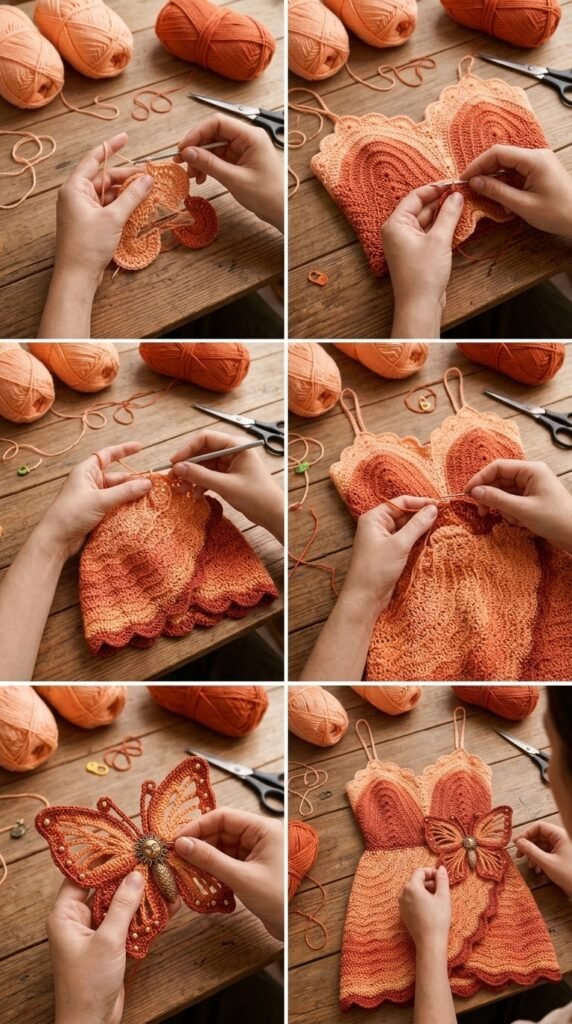
Bodice
With 3.5 mm hook and Color A, chain 84 (92, 100, 108, 116). Being careful not to twist, join with sl st to form a ring.
Rnd 1: Ch 2 (does not count as st), dc in each ch around. Join with sl st to first dc. – 84 (92, 100, 108, 116) dc
Rnds 2–8 (9, 10, 11, 12): Ch 2, dc in each st around. Join.
Place markers for underarms: counting from the join, place a marker after 21 (23, 25, 27, 29) stitches (left front), after another 21 (23, 25, 27, 29) stitches (back), and after another 21 (23, 25, 27, 29) stitches (right front). The remaining stitches form the second underarm section.
Armhole Round: Ch 2, dc to first marker, ch 6 (6, 7, 7, 8) for underarm, sk the next 21 (23, 25, 27, 29) sts, dc across back to next marker, ch 6 (6, 7, 7, 8), sk remaining sts for second underarm. Join. – 48 (52, 57, 61, 66) dc + 2 underarm chains
Continue even in dc with Color A for 1 more round, then change to Color B. Work 3 (3, 4, 4, 5) rounds in Color B. Change to Color C and work the remaining bodice rounds until the total bodice depth from shoulder line measures 5.5 (6, 6.5, 7, 7.5) in / 14 (15, 16.5, 18, 19) cm. Do not fasten off.
Skirt Setup
Switch to 3.75 mm hook. Still using Color C, work one setup round to create the foundation for the butterfly lace:
Setup Round: Ch 1, sc in each dc and work 2 sc in each underarm chain space around. Join. Adjust stitch count if needed so the total is a multiple of 12. – approximately 96 (108, 120, 132, 144) sc
Butterfly Lace Skirt
The butterfly motif is worked over 12 stitches and 4 rounds. The pattern below is written for continuous rounds; the motif repeats around.
Butterfly Motif – Round 1: Ch 3 (counts as dc here and throughout the lace), sk 2 sc, *(dc, ch 1, dc, ch 1, dc) in next sc (wing cluster), ch 2, sk 3 sc, sc in next sc, ch 2, sk 3 sc; repeat from * around, ending with join to top of beg ch-3.
Round 2: Sl st into first ch-1 sp of first cluster, ch 3, (dc, ch 1, dc) in same sp, *ch 1, (dc, ch 1, dc, ch 1, dc) in next ch-1 sp of same cluster, ch 2, sk next ch-2, sc in next sc, ch 2, sk next ch-2, (dc, ch 1, dc) in first ch-1 sp of next cluster; repeat from * around, join.
Round 3: Sl st into first ch-1 sp, ch 1, sc in same sp, *ch 3, sc in next ch-1 sp, ch 3, sc in next ch-1 sp, ch 1, (dc, ch 1, dc) in next sc (center body), ch 1, sc in next ch-1 sp; repeat from * around, join.
Round 4: Ch 1, *sc in next sc, 3 sc in next ch-3 sp, sc in next sc, 3 sc in next ch-3 sp, sc in next sc, sc in next ch-1 sp, (dc, ch 3, sl st in first ch of ch-3 for picot, dc) in next ch-1 sp (body detail), sc in next ch-1 sp; repeat from * around, join.
This completes one full butterfly band. Change to Color D at the end of Round 4.
Repeat the 4-round butterfly sequence, changing colors as follows for the ombre effect:
- Next full motif band: Color D
- Next full motif band: Color D
- Next full motif band: Color E
- Final motif band (or partial for length): Color E
For larger sizes, add extra motif bands as needed to reach the desired skirt length. Each full band adds approximately 2 in / 5 cm after blocking. Work until the total dress length matches the finished measurements or your preferred length. Fasten off after the final round.
Special Techniques / Additional Elements
Flutter Sleeves (make 2)
With 3.5 mm hook and Color B, join yarn at the center of one underarm chain.
Row 1: Ch 2, work 18 (20, 22, 24, 26) dc evenly around the armhole opening (working into the skipped stitches and the underarm chain). Turn.
Row 2: Ch 2, 2 dc in first st, dc across to last st, 2 dc in last st. Turn. – 20 (22, 24, 26, 28) dc
Row 3: Ch 2, 2 dc in first st, dc across to last st, 2 dc in last st. Turn.
Row 4: Ch 1, sc in each st across. Fasten off.
Repeat for the second sleeve. The gentle increases create a soft flutter that looks like butterfly wings when the arm is raised.
Optional Waist Detail
With Color C or D, surface-crochet a simple chain of slip stitches just below the bodice-skirt join if you want a subtle definition line. Alternatively, weave a narrow ribbon through the spaces of the first lace round and tie in a soft bow at the back or side.
Assembly and Finishing
Weave in all ends on the wrong side, taking special care at the color-change points so the transitions stay smooth. Because the dress is worked in one piece, there is no seaming required for the body. The only finishing is attaching the flutter sleeves (already joined) and weaving ends.

If the neckline feels too wide for the wearer, work one round of single crochet around the top edge, decreasing 4–6 stitches evenly, then fasten off.
Blocking and Care
Wet-block the finished dress for the best lace definition. Soak in lukewarm water with a mild detergent for 15–20 minutes. Gently squeeze out water and roll in a towel. Lay flat on a blocking surface. Pin the butterfly motifs open so the wings are clearly shaped and the picots sit flat. Shape the flutter sleeves into soft curves. Allow to dry completely.
Care: Hand wash in cool water, reshape, and dry flat. Do not wring or hang while wet. The cotton blend will soften beautifully with each wash while holding the ombre colors well if washed with like colors.
Fit and Troubleshooting Tips
If the bodice feels tight, go up half a hook size for the solid dc section only. If the lace looks cramped, make sure you are using the larger 3.75 mm hook and blocking the motifs fully open.
Uneven color transitions usually come from changing colors in the middle of a round. Always change at the end of a round and carry the unused yarn loosely up the inside if you prefer not to cut.
Flutter sleeves that curl can be tamed with a light steam or by working the final sc row a bit tighter. If they feel too short, add one more increase row before the sc edge.
For a longer dress, simply add more butterfly bands before fastening off. For a shorter, everyday length, stop after three or four bands and finish with a simple sc edging in the final color.
FAQ’s
Can I use a single ombre cake yarn instead of five separate colors?
Yes. Choose a fingering-weight ombre cake that moves through gold, apricot, coral, rose, and violet tones. Wind off approximate sections that match the yardages listed, or simply work until the color shifts naturally and adjust the number of motif bands to keep the visual balance.
Is this dress suitable for a beginner?
It is written for intermediate crocheters because of the multi-round butterfly lace and managing color changes while working in the round. Confident beginners who have already completed a few lace projects or color-work pieces can manage it with careful counting and a practice motif.
How do I make the dress longer or shorter?
Each full butterfly band adds about 2 inches after blocking. Add or remove complete 4-round bands before the final color to adjust length. You can also work a partial final band and finish with a simple single-crochet edge.
Can I add longer sleeves or make it sleeveless?
For longer sleeves, continue the flutter sleeve increases and then work even for the desired length before the final sc row. For a sleeveless version, simply skip the flutter sleeve section and work one round of single crochet around each armhole for a clean finish.
What if my butterfly motifs look uneven or closed?
Make sure you are using the larger 3.75 mm hook for the lace and that you are blocking the finished dress. Pin each wing open while damp so the clusters and picots sit flat. Consistent tension on the chain spaces also helps the motifs open evenly.
Can I sell finished dresses made from this pattern?
Yes. You are welcome to sell items you make from this free pattern. Please credit the design when possible and do not sell or distribute the written pattern itself.
Will the ombre colors bleed when washed?
With most good-quality cotton or cotton-blend yarns the colors are stable, especially if you wash the finished dress the first time by itself in cool water. Always check your specific yarn label and, when in doubt, rinse the individual skeins before starting the project.
Final Thoughts
There is a quiet joy in watching a child spin in a dress that looks like a piece of the sky. The butterflies open and close with every movement, the colors shift as she turns, and somehow the whole thing feels both delicate and durable at the same time. I hope this Sunset Ombre Butterfly Crochet Dress brings that same feeling into your home.
If you make one, I would love to see the colors you chose and the little person who wears it. Share a photo or leave a note—it always makes the stitching feel even more worthwhile. Happy crocheting, and may every sunset remind you to pick up your hook.


Leave a Reply
You must be logged in to post a comment.