


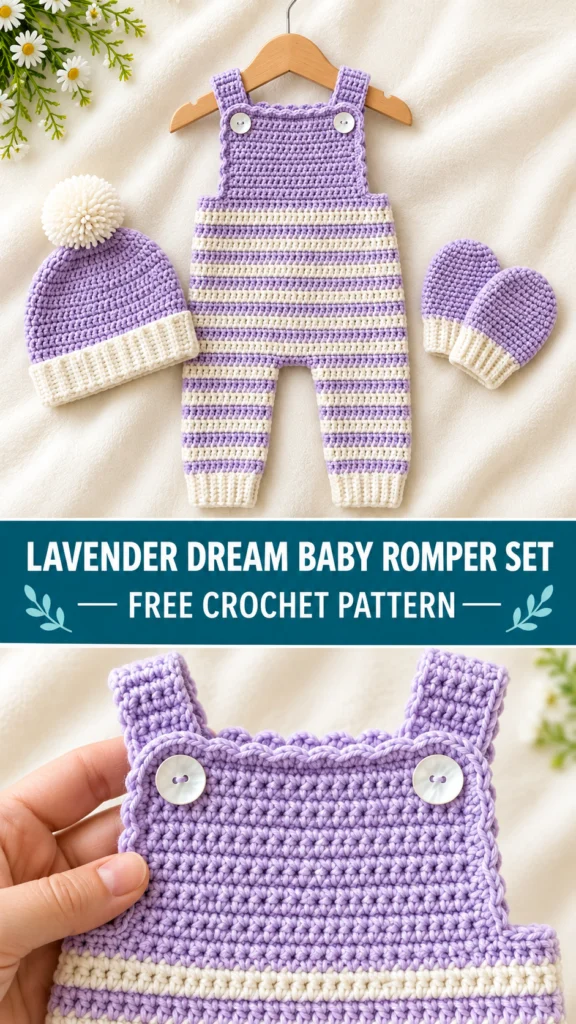
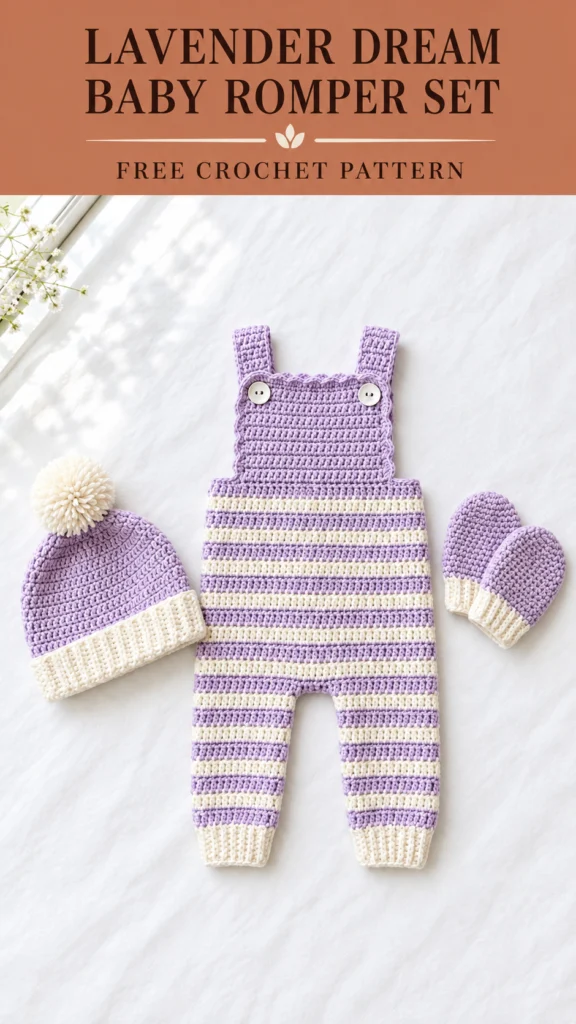
Baby rompers solve a very specific problem: keeping tiny humans covered while they wiggle, crawl, and roll. The Lavender Dream Baby Romper Set handles all of that in soft lilac lace, and the pattern costs absolutely nothing. Let’s make something adorable.
Why the Lavender Dream Baby Romper Set Wins Hearts
This set delivers boutique-level cuteness for the price of one skein. You get a finished romper and matching accessories in an afternoon, which matters when babies outgrow everything in weeks.
The lavender color does serious work. Soft lilac flatters every baby skin tone and photographs beautifully against neutral backdrops. It reads dreamy and sweet without veering into saccharine territory.
IMO, the romper silhouette beats a dress for daily wear. Snaps and buttons make diaper changes manageable, while the short legs let babies move freely.
Want a set that works for photos, showers, and everyday wear alike? This one earns its place in the nursery.
Choosing Yarn That Pampers Baby Skin
Baby skin is sensitive. Scratchy yarn turns a beautiful romper into a fussy, unwearable garment.
Best Fiber Options
- Soft cotton: Breathable, gentle, and machine washable. The clear winner.
- Cotton-bamboo blends: Silky and cool for warm climates.
- Cotton-acrylic blends: Budget-friendly with easier care.
- Mercerized cotton: Adds subtle sheen for special occasions.
Skip wool and alpaca entirely. They itch, they felt, and babies protest loudly.
Weight and Yardage
DK or sport weight cotton works best for a romper that drapes without gaping.
Plan on roughly 300 to 500 yards depending on size. Baby sizes vary wildly, so buy an extra skein to be safe.
Lavender Palettes Worth Trying
Lavender covers a range of soft, muted tones:
- Classic lavender: Muted, vintage, endlessly photogenic.
- Pale lilac: Softer and more delicate.
- Deep violet-lavender: Richer and more dramatic.
- Lavender + cream + sage: Earthy and sophisticated.
Pick a shade that suits the occasion. Pale lilac works for everyday; deeper violet suits formal photos.
Stitches and Skills You’ll Need
Good news for beginners: this set uses a small, friendly stitch vocabulary. Nothing exotic required.
- Chain (ch): Foundation and the decorative details.
- Slip stitch (sl st): Joining rounds and finishing edges.
- Single crochet (sc): The main body fabric.
- Half double crochet (hdc): Faster growth with a softer drape.
- Double crochet (dc): Adds height and open texture.
- Shell stitches: Create the decorative lace detail.
- Picot: Optional, but it adds delicate points to the edges.
If you can chain and single crochet, you can make this romper. The pattern repeats so consistently that your hands take over by row three.
Step-by-Step: Crocheting the Lavender Dream Baby Romper Set
Step 1 — Measure Your Baby
Baby sizing is chaos, so measure the actual child. Grab their chest, waist, torso length, and inseam.
Standard sizes run newborn through 24 months, but real measurements beat labels every time. Write them down before you start.
Add ease for movement and diaper bulk. Babies need room to wiggle — a tight romper becomes a wrestling match at every change.
Step 2 — Build the Bodice
Start at the neckline and work downward. This lets you try the romper on as you go, which matters when the wearer can’t stand still.
Chain a foundation that fits the chest measurement, join into a ring, and work even rounds of single crochet. Mark your increase points with stitch markers.
Increase gradually at the sides to create a gentle A-line shape. Slow and steady wins — sudden jumps create weird bulges.
Step 3 — Shape the Body and Waist
Here’s where fit matters most. Work even rows through the torso, then decrease gently at the waist to create shape.
Add a few increase rounds at the hip to accommodate diaper bulk. Try it on constantly — crochet fabric behaves differently on a body than flat on a table.
Keep your shaping symmetrical. Asymmetry shows up immediately once the romper drapes.
Step 4 — Split for the Legs
Once you reach the crotch, split your work into two legs. Join at the center and work each leg separately in the round.
Work the short legs in single or half double crochet. Keep the legs loose so they don’t bind during crawling.
Continue until the legs reach your desired length. Short legs suit summer; longer legs work for cooler months.
Step 5 — Add the Lace Details and Snaps
Small touches make this romper feel special. Work a delicate lace trim along the neckline, cuffs, and hems using shell stitches or picots.
Add snap closures along the inner legs for easy diaper changes. Snaps beat buttons because they open and close one-handed, which matters at 3 a.m.
Consider a small bow or flower at the center front. It photographs beautifully and hides any imperfect joins.
Step 6 — Finish and Block
Work a firm single crochet border around every opening. This stops curling and gives the romper a polished, intentional edge.
Weave in every end thoroughly. Babies find loose threads and unravel garments with alarming efficiency.
Blocking is essential here. Pin the romper into shape, spritz with water, and let it dry completely. Cotton holds the blocked shape beautifully.
Customizing Size, Color, and Style
Adjusting for Different Ages
The pattern grades easily because the stitch repeat stays consistent. Add or remove rounds to adjust length.
For newborns, shorten the legs and torso. For older babies, add length and width proportionally.
Color Variations Beyond Lavender
Lavender is the signature, but the design translates beautifully:
- Soft mint: Fresh and summery.
- Blush pink: Sweet and feminine.
- Butter yellow: Sunny and cheerful.
- Classic white: Timeless and photo-ready.
Making a Matching Set
Sibling matching never goes out of style. Make a coordinating version in a different size using the same yarn and color.
For an older sibling, add length to the legs and wider straps. Same romper, scaled up.
Troubleshooting Common Problems
The romper stretches out of shape. Your yarn has too much give. Switch to cotton or add a lining for structure.
The neckline gapes. Add a round of single crochet with slight decreases around the opening to pull it in.
The lace sections look uneven. Your tension varies between stitches. Practice the pattern repeat on a swatch until it feels automatic.
The legs bind during crawling. Your leg openings are too tight. Add a few stitches or switch to a larger hook for the leg section.
The romper shrinks in the wash. Cotton shrinks slightly. Wash cold and lay flat to dry to preserve the size.
You Might Also Like
- Cotton Candy Pink Chameleon Amigurumi Free Crochet Pattern
- Dusty Blue Sailboat Baby Dress Free Crochet Pattern
- Coral Peach Summer Crochet Dress Free Pattern
- Peachy Keen Summer Toddler Dress Free Crochet Pattern
- Lilac Starflower Lace Dress Crochet Pattern
FAQ’s
Is this pattern really free?
Yes. The Lavender Dream Baby Romper Set pattern is available at no cost on the designer’s site. You only pay for yarn.
What sizes does the pattern cover?
Most versions cover newborn through 24 months, with instructions for adjusting beyond those ranges.
How long does this set take to make?
Plan for four to six hours for the full set once you learn the repeat. Smaller sizes work up faster.
Can I use worsted weight yarn instead of DK?
Yes, but size down your hook. Worsted weight with an F hook creates a slightly denser romper that still drapes well.
Is this set suitable for beginners?
Absolutely. You only need chain, single crochet, and double crochet skills to finish the whole project.
Can I sell rompers made from this pattern?
Check the designer’s terms before selling finished items. Most free patterns allow personal use but restrict commercial sales.
A Romper Set Worth Making Twice
The Lavender Dream Baby Romper Set delivers everything you want from a baby project — fast, affordable, comfortable, and ridiculously cute. It uses simple stitches, works up in an afternoon, and survives real baby life.
Pick your lavender shade, block it properly, and dress your tiny human in something handmade. Then make a second one, because they’ll outgrow the first by autumn.
FYI, matching mom-and-me versions exist too. Consider yourself enabled.



Leave a Reply
You must be logged in to post a comment.