


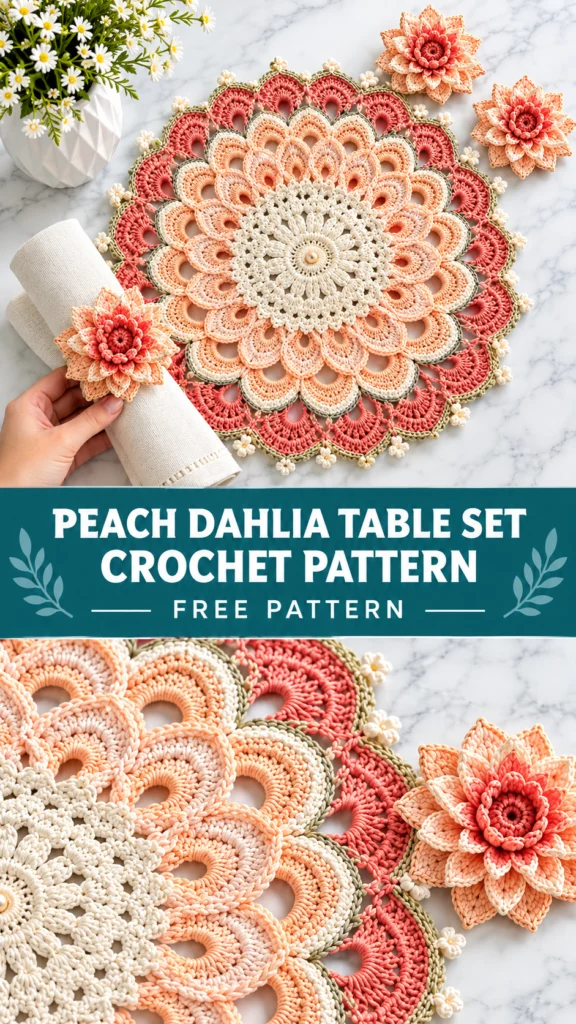
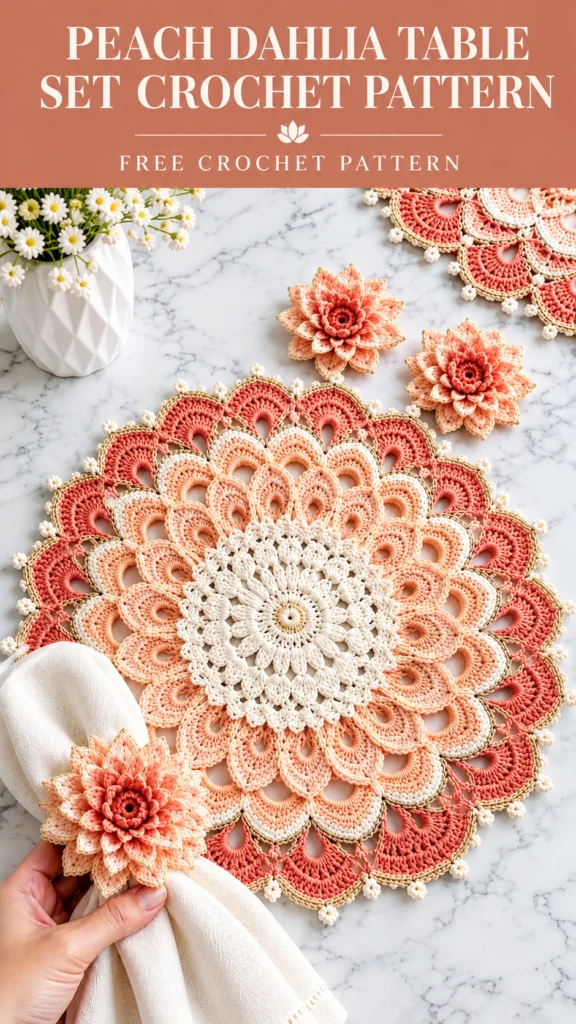
A matching table set makes dinner feel like an event, even when you’re eating leftovers alone. The Peach Dahlia Table Set delivers coordinated placemats, a runner, and coasters in warm peachy tones that flatter every table. Grab your thread — your dining room is about to look intentional.
Why the Peach Dahlia Table Set Deserves Your Table
Coordinated table sets beat mismatched linens every single time. This pattern gives you a unified look without hunting through stores for pieces that vaguely match.
The dahlia motif carries across every item in the set. Layered petals create real texture, so the set looks handcrafted and expensive rather than flat and printed.
IMO, peach is the smartest neutral nobody talks about. It warms up cool-toned dining rooms and pairs beautifully with wood, white, and sage green.
Plus, you can make as many pieces as your table needs. Four placemats? Eight? A runner for the holidays? The pattern scales to fit.
Choosing Thread and Yarn for Table Linens
Table linens take abuse. Hot plates, spilled wine, and daily use demand materials that hold up.
Best Fiber Options
- Size 3 cotton thread: Sturdy, washable, holds lace definition beautifully.
- Mercerized cotton: Adds subtle sheen and resists fading.
- Cotton-linen blends: Earthy texture with excellent durability.
- Worsted weight cotton: For chunkier, more casual table sets.
Skip acrylic entirely. It melts under hot dishes and pills after a few washes.
Hook Size and Tension
Pair size 3 thread with a D or E hook for placemats that lie flat and hold their shape.
Tension matters more than usual here. Loose tension makes saggy petals; tight tension makes curling linens. Aim for consistent, moderate tension throughout the entire set.
Peach Palettes Worth Trying
Peach covers a wider range than most people realize:
- Soft blush peach: Pale, romantic, and wedding-friendly.
- True peach: Warm, sunny, and slightly retro.
- Coral peach: Bolder and more saturated.
- Peach + cream + sage: Earthy and sophisticated.
Use one shade as the base and a lighter tone for the petal highlights. Consistency across the set matters more than variety for a coordinated look.
Stitches and Techniques for Dahlia Blooms
Good news: dahlias use the same stitches as every other crochet flower. The magic lives in layering.
- Magic ring: The starting point for every bloom.
- Chain (ch): Petal foundations and lace gaps.
- Slip stitch (sl st): Joining rounds and shaping petals.
- Single crochet (sc): Dense centers and firm borders.
- Double crochet (dc): The main petal stitch.
- Treble crochet (tr): Longer outer petals for fullness.
- Picot: Optional, but it adds pointed petal tips.
If you can make a basic flower, you can make this entire set. The only variation comes in how you arrange and attach the blooms.
Step-by-Step: Crocheting the Peach Dahlia Table Set
Step 1 — Start With the Placemat Base
Every placemat begins with a center ring. Make a magic ring, or chain four and join with a slip stitch if magic rings annoy you.
Work rounds of double crochet outward, increasing evenly to keep the circle flat. A flat circle needs consistent growth — usually eight to twelve increase points per round.
Stop when the placemat reaches your desired diameter. Standard placemats run 13 to 15 inches across.
Step 2 — Build the First Dahlia Bloom
Each bloom starts with a magic ring in your accent color. Work six single crochets into the ring, then join.
Round two doubles the stitch count. Round three switches to double crochets for the inner petals.
Round four adds treble crochets for the outer petals. Vary the petal height slightly so the bloom looks organic rather than mechanical.
Step 3 — Attach the Blooms to the Base
Arrange your finished dahlias on the placemat base before sewing anything down. Rhythm matters more than symmetry — think natural garden growth.
Sew each bloom using your yarn needle and matching thread. Anchor through the center and one petal so the flower stays flat.
Cluster blooms near the center and space them out toward the edges. That distribution looks most natural.
Step 4 — Crochet the Table Runner
The runner uses the same bloom motif but stretches long and narrow. Start with a foundation chain instead of a ring and work in rows.
Add blooms at regular intervals along the runner’s length. Odd numbers look better than even — three, five, or seven blooms down the center.
Keep the runner’s edges firm with a single crochet border. Floppy runners slide off tables and look sloppy.
Step 5 — Make the Matching Coasters
Coasters use just the first three rounds of the placemat pattern. They work up in about 15 minutes each, making them perfect for using up leftover thread.
Stack four to six coasters per set. Consistent tension across all of them makes the set look polished rather than patchy.
Add a small dahlia bloom to each coaster center for cohesion. One bloom per coaster is plenty.
Step 6 — Border, Block, and Finish
Work a firm single crochet border around every piece in the set. This stops curling and gives each item a polished, intentional edge.
For a decorative finish, add a picot edge: single crochet, chain three, slip stitch into the same stitch, repeat around.
Blocking transforms this set from homemade to heirloom. Pin every piece to a blocking mat, spritz with water, and let them dry completely.
Customizing Size, Shape, and Style
Adjusting for Different Table Sizes
Placemat size scales with your table. Measure your current placemats and match the diameter, or go slightly larger for a more dramatic look.
Runner length should overhang the table by six to eight inches on each side. Measure your table before you start rather than guessing.
Shape Variations
Round placemats dominate this pattern, but you have options:
- Square: Work corners with chain spaces at four points.
- Oval: Start with a foundation chain instead of a ring.
- Rectangular runner: Work in rows with blooms spaced evenly.
- Hexagon: Use six increase points for a geometric look.
Coordinating Your Full Set
A matching set looks intentional. Use the same base color across all pieces and rotate which accent shade forms the blooms.
Peach base with cream blooms. Peach base with sage blooms. Same family, different personalities.
Troubleshooting Common Problems
The placemats ripple and won’t lie flat. Too many increases. Reduce to one increase per repeat instead of two.
The dahlia blooms look floppy. Your tension ran loose. Go down a hook size or work an extra petal layer for density.
The runner curls at the edges. Add a firm single crochet border and block aggressively. Curling usually means the outer rows lack density.
The colors bleed together at joins. Join new shades at the end of a round, never the middle. Clean joins create crisp color transitions.
The finished set feels floppy. Your thread is too fine for the hook. Drop a hook size or switch to a heavier thread weight.
You Might Also Like
- Autumn Dahlia Hair Vine Crochet Pattern
- Mint Luna Moth Crochet Cape Pattern
- Rainbow Pastel Dragon Amigurumi Plush Free Crochet Pattern
- Peacock Feather Placemat Crochet Pattern
- Candy Stripe Snake Amigurumi Free Crochet Pattern
FAQ’s
How long does the full set take to make?
Plan on 12 to 20 hours for a complete set of four placemats, a runner, and six coasters. Coasters work up fast; placemats take the longest.
Can I use regular worsted weight yarn instead of thread?
Yes, but size up your hook. Worsted weight with an H or I hook makes chunkier, more casual table linens that suit everyday use.
Are these table linens machine washable?
Cotton thread handles gentle cold washing. Lay them flat to dry and re-block — the dryer will shrink and distort the lace.
How many placemats should I make?
Four is standard, six is generous, eight covers a dinner party. Make them in batches so your tension stays consistent across the set.
Can I mix and match colors across the set?
Absolutely. Keep the base color consistent and vary the bloom shades for a coordinated but interesting look. Just avoid too many competing colors.
How do I store crochet table linens without crushing them?
Roll them loosely or stack them flat in a drawer. Never fold lace tightly — creases settle in and take forever to relax, even after blocking.
A Table Set Worth Setting Out
The Peach Dahlia Table Set turns everyday meals into something that feels considered and beautiful. It uses accessible stitches, builds through satisfying repeats, and delivers a coordinated set that looks like it came from a boutique.
Pick your peach palette, block everything properly, and set your table proudly. Then invite someone over for dinner, because these pieces deserve to be seen.
FYI, once you finish one set, you’ll start planning a second in a different color. Consider yourself warned.


Leave a Reply
You must be logged in to post a comment.