

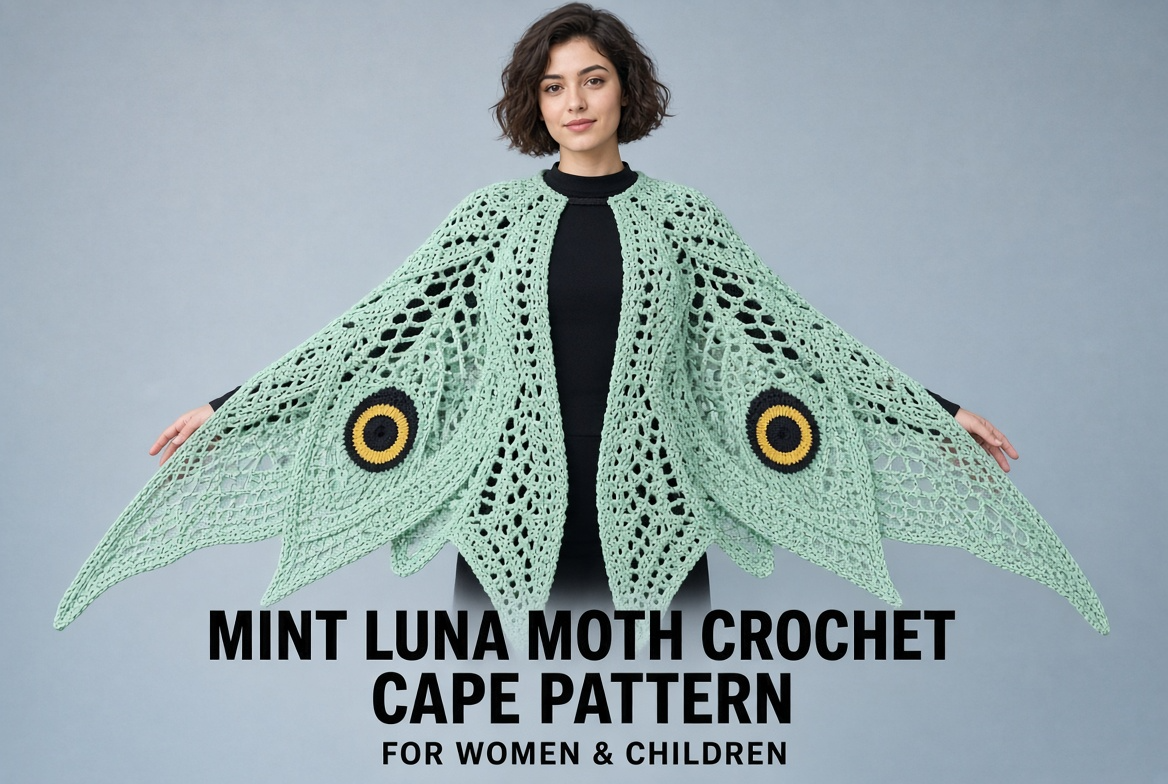
Luna moths only live about a week, which feels tragically short for something that beautiful. The Mint Luna Moth Crochet Cape lets you keep that magic around all season, draped over your shoulders in soft green lace. Fair warning: people will stop you in the street to ask where you bought it.
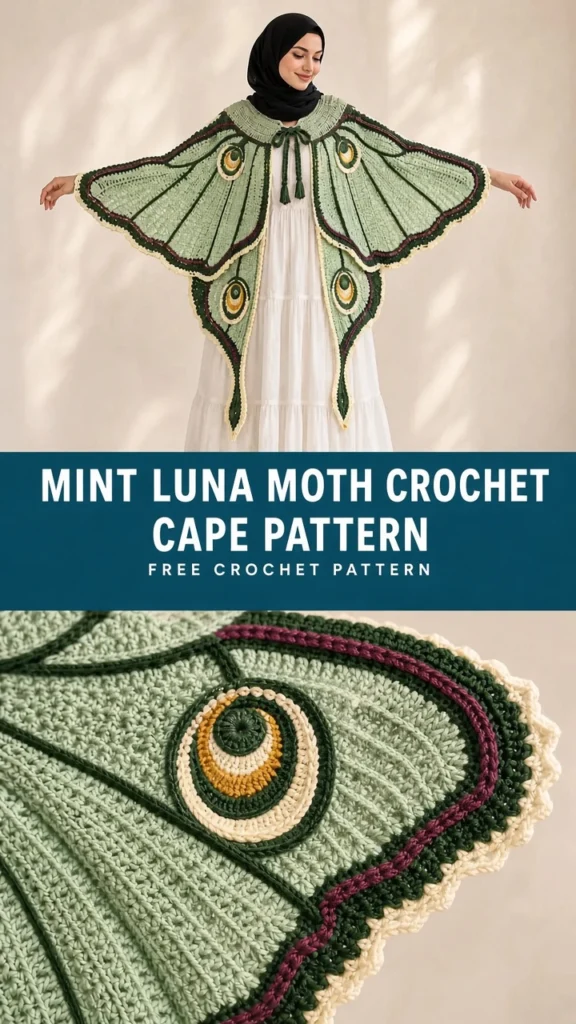
Why the Mint Luna Moth Cape Belongs in Your Closet
This cape balances drama and wearability in a way most statement pieces never manage. It drapes like something from a fantasy novel, but you can actually wear it to the grocery store without looking absurd.
The mint color choice does serious work. Soft mint flatters nearly every skin tone and reads as ethereal rather than costume-y. It pairs with denim, linen, and basically anything neutral in your closet.
IMO, the moth wing motif is what elevates this above a standard crochet shawl. The wing shapes fan outward from the center back, creating that signature luna silhouette.
Plus, capes hide a multitude of sins. Bad posture? Unflattering top? Nobody notices under a cape this pretty.
Picking Yarn That Captures the Luna Magic
Yarn choice makes or breaks this project. Get it wrong and your ethereal moth cape turns into a heavy blanket with delusions of grandeur.
Best Fiber Options
- Cotton-silk blends: Luxurious drape, subtle sheen, holds lace detail beautifully.
- Mercerized cotton: Crisp stitch definition with a gentle shimmer.
- Bamboo-cotton blends: Silky, flowing, and cool against the skin.
- Fine merino or alpaca: Warm and soft for autumn and winter versions.
Skip heavy acrylics. They pill, they sag, and they completely kill the delicate moth aesthetic.
Weight and Yardage
Fingering or sport weight yarn works best for that airy, wing-like drape. Anything chunkier turns the lace sections into dense fabric.
Plan on roughly 800 to 1,200 yards depending on cape length and your size. Buy an extra skein — running out mid-wing is a special kind of heartbreak.
Mint Shades Worth Trying
Mint covers a wider range than most people realize:
- Pale seafoam: Soft, barely-there green with a dreamy quality.
- True mint: Bright, fresh, and slightly retro.
- Sage mint: Earthier and more muted, great for fall.
- Mint with silver threads: Adds literal sparkle to the wing edges.
Pick a shade that flatters your undertones. Cool-toned folks shine in true mint; warm-toned folks rock sage and seafoam.
Stitches and Skills You’ll Need
Good news: the luna moth motif looks complex but relies on stitches you already know. The magic lives in the arrangement, not the technique.
- Chain (ch): Foundation and the open lace gaps.
- Slip stitch (sl st): Joining rounds and shaping wing points.
- Single crochet (sc): Firm edges and structural rows.
- Double crochet (dc): The main drapey fabric.
- Treble crochet (tr): Creates the sweeping wing curves.
- Shell or fan stitches: Build the wing texture.
- Picot: Optional, but it adds an ethereal edge to the wing tips.
If you can chain, single crochet, and double crochet, you have the foundation. The wing sections just group those stitches into graceful arcs.
Step-by-Step: Crocheting the Mint Luna Moth Cape
Step 1 — Swatch and Measure Honestly
Gauge decides whether this cape drapes or strangles. Work a 4-inch swatch in the main stitch pattern and measure it before and after blocking.
Count your stitches and rows, then compare against the pattern gauge. Adjust your hook size accordingly — smaller hook for looser tension, larger hook for tighter tension.
Block your swatch the same way you’ll block the finished cape. Lace fabric changes dramatically after blocking, and skipping this step leads to unpleasant surprises.
Step 2 — Build the Center Back Panel
The cape typically starts at the center back and grows outward. Chain your foundation in a multiple that fits the wing repeat, then work the first rows in double crochet.
Keep the center panel even and flat. This section anchors the whole piece, so any distortion here echoes through the entire cape.
Mark your increase points with stitch markers. You’ll reference them constantly as the wing shapes develop.
Step 3 — Shape the Luna Moth Wings
Here’s where the magic happens. Each wing grows from the center back in a sweeping fan, using graduated treble crochets and chain spaces.
Start each wing with shorter stitches near the spine, then increase height as you move outward. The result mimics the natural curve of real luna moth wings.
Work both wings symmetrically. Count your stitches on each side — asymmetry shows up immediately once the cape drapes.
Step 4 — Add the Lace Detail
Between the wings, work open lace sections that create the moth’s delicate body shape. Chain arches and shell stitches fill these spaces, adding texture without bulk.
The lace sections should feel airy and open. If they look dense, you’re either using too small a hook or working too many stitches per repeat.
Vary the lace slightly across sections for organic texture. Perfectly uniform lace looks mechanical; subtle variation looks alive.
Step 5 — Build the Neckline and Front Edges
Once the wings reach their full span, transition into the neckline. Decrease gradually at the top edges to create a soft curve that sits on your shoulders.
Work the front edges straight down from the shoulder points. These become the opening edges of the cape.
Try it on constantly. Crochet fabric behaves differently on a body than flat on a table, and capes especially benefit from real-time fitting.
Step 6 — Add the Border and Closure
Work a firm single crochet border around every edge. This stops curling and gives the cape a polished, intentional finish.
For the closure, you have options:
- Add a single button at the neck with a crochet loop.
- Work a chain tie that fastens at the front.
- Use a decorative shawl pin for adjustable closure.
- Leave it open for a draped, relaxed look.
Weave in every end and block the finished cape. Blocking transforms this piece from nice to genuinely stunning.
Customizing Fit, Length, and Style
Adjusting Length
A cropped cape hits at the waist and works beautifully with high-rise jeans. Longer versions reach mid-thigh or knee for dramatic, witchy energy.
Decide your length before you start the wing section. The wings need to land where you want them visually.
Grading for Different Sizes
The pattern grades easily because the wing repeat stays consistent. Add or remove pattern repeats around the back to adjust width.
For broader shoulders, work extra rows before the neckline decreases. For narrower frames, skip a few increase rows and check the fit as you go.
Color Variations Beyond Mint
Mint is the signature, but the design translates beautifully:
- Lavender: Soft, dreamy, and slightly mystical.
- Pale grey-blue: Moody and elegant, like a moth at dusk.
- Cream: Timeless and bridal-adjacent.
- Deep forest green: Bold and earthy for autumn wear.
Troubleshooting Common Problems
The wings sag instead of holding their shape. Your yarn lacks body. Switch to cotton or a cotton blend, and block more firmly.
The cape pulls at the neckline. You decreased too aggressively. Frog back and spread the decreases over more rows.
The lace sections look uneven. Your tension varies between stitches. Practice the pattern repeat on a swatch until it feels automatic.
The edges curl despite the border. Block the cape more aggressively, stretching the border flat. Some curl relaxes with proper blocking.
The cape feels too heavy. Your yarn weight is too thick for the design. Drop to fingering weight for that floating, wing-like drape.
You Might Also Like
- Rainbow Pastel Dragon Amigurumi Plush Free Crochet Pattern
- Peacock Feather Placemat Crochet Pattern
- Candy Stripe Snake Amigurumi Free Crochet Pattern
- Coral Citrus Lace Placemat Crochet Pattern
- Classic Cream Highland Cow Amigurumi Free Crochet Pattern
FAQ’s
How long does this cape take to make?
Plan for 15 to 25 hours depending on your speed and chosen length. The wing sections work up faster than they look once you learn the rhythm.
Is this pattern beginner-friendly?
It suits intermediate beginners. You need confidence with chain, single crochet, double crochet, and treble crochet before tackling the wing shaping and lace.
Can I make this cape in a heavier yarn for winter?
Yes. Use worsted weight with a larger hook and expect a denser, warmer cape. The wing detail softens but still reads clearly.
How do I block a cape this size?
Use a large blocking mat or a clean bedsheet over a carpet. Pin the cape into shape, spritz with water, and let it dry fully before removing the pins.
What’s the best closure for a crochet cape?
A single statement button at the neck keeps things simple and secure. Shawl pins offer more flexibility if you want adjustable drape.
Can I wear this cape in warm weather?
Absolutely, if you choose cotton or bamboo blends. Lightweight, breathable fibers keep the cape comfortable even on mild spring and summer evenings.
Final Thoughts
The Mint Luna Moth Cape rewards patience with a piece that feels genuinely magical to wear. It uses accessible stitches, builds through satisfying repeats, and delivers a finished garment that looks like it belongs in a fantasy wardrobe.
Pick your mint shade, block it properly, and wear it somewhere worth being seen. Then prepare yourself for the compliments, because this cape attracts them.
FYI, once you finish one, you’ll start planning a second in a different color. Consider yourself warned.




Leave a Reply
You must be logged in to post a comment.