


I can’t pull the headings from that URL because it returns a 404 error — the page either moved, got deleted, or never existed at that address. Try checking the site’s pattern index, searching the site directly, or checking the Wayback Machine for an archived copy. In the meantime, here’s the article using natural headings for the topic. Share the original heading list and I’ll swap them in.
Placemats never get the credit they deserve. They sit under your pasta, soak up sauce splatter, and somehow still make your table look like you have your life together. The Coral Citrus Lace Placemat delivers all that plus a color palette that screams summer without trying too hard. Let’s make a set.
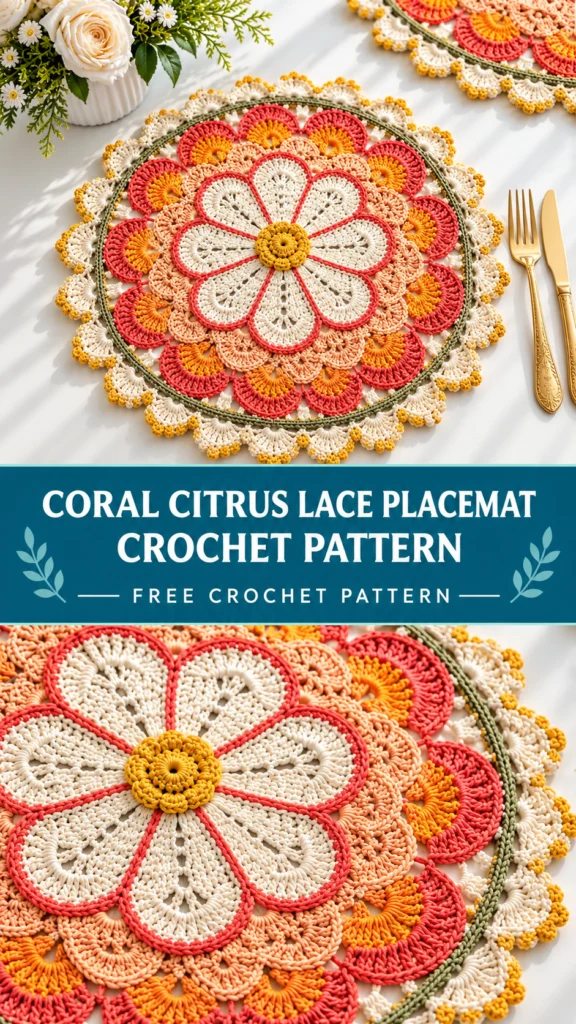
Why the Coral Citrus Lace Placemat Earns Its Spot on Your Table
This pattern delivers maximum visual impact for minimal effort. You work in the round, repeat a handful of stitches, and end up with something that looks like it came from a boutique.
The coral and citrus color combination does the heavy lifting. Warm coral paired with zesty orange and lemon tones creates a palette that feels fresh, bright, and slightly retro in the best way.
IMO, lace placemats beat fabric ones every time. They wash up easier, dry faster, and add texture that flat cotton just can’t match.
Plus, they make genuinely good gifts. Who doesn’t want a handmade placemat set that costs less than a fancy candle?
Picking Yarn That Makes Lace Look Expensive
Lace patterns live and die by yarn choice. Get it wrong and your delicate placemat looks like a tangled dishcloth.
Best Fiber Options
- Cotton thread or size 3 cotton: Crisp, sturdy, holds lace definition beautifully.
- Mercerized cotton: Adds a subtle sheen that catches light on the table.
- Cotton-linen blends: Slightly rustic texture with excellent body.
- Bamboo-cotton blends: Softer drape, better for casual everyday mats.
Skip acrylic entirely. It pills, it sags, and hot plates do unpleasant things to it.
Thread Weight and Hook Size
Size 3 cotton thread with a D or E hook hits the sweet spot for placemats. You get lacy detail without spending three weeks on one mat.
Finer threads like size 10 create stunning heirloom pieces, but your hands will file a complaint. Save those for special occasions.
Color Combinations to Try
The signature coral-citrus palette works because it balances warm and bright. Try these variations:
- Coral + tangerine + cream: Classic, sunny, endlessly cheerful.
- Peach + lemon + soft white: Softer and more romantic.
- Watermelon + lime + ivory: Playful and slightly tropical.
- Terracotta + marigold + sand: Earthy and autumn-ready.
Pick a main color and use the others as accent rounds. The ombre effect happens naturally as you switch shades through the rounds.
Stitches and Skills You Need
Good news for anyone who fears lace: this pattern uses a tiny stitch vocabulary. Nothing exotic, nothing fiddly.
- Chain (ch): Your foundation and the lace gaps.
- Slip stitch (sl st): For joining rounds and traveling across spaces.
- Single crochet (sc): Dense sections that anchor the lace.
- Double crochet (dc): The workhorse for lacy arches.
- Treble crochet (tr): Creates taller loops and petal shapes.
- Picot: Optional, but it adds that fancy vintage edge.
If you can chain and double crochet, you can make this placemat. The pattern repeats so consistently that your hands take over by round three.
Step-by-Step: Crocheting the Coral Citrus Lace Placemat
Step 1 — Start With a Magic Ring
Every round placemat begins at the center. Make a magic ring, or chain four and join with a slip stitch if magic rings fight you.
Work your first round of single crochets into the ring. Aim for 12 to 16 stitches depending on your thread weight — enough to lie flat without gaps.
Pull the ring closed firmly. A loose center shows up immediately in a finished lace piece.
Step 2 — Build the First Lace Rounds
Round two establishes your increase pattern. Double your stitch count by working two stitches into each stitch from the previous round.
Round three spaces out chain arches. Skip a stitch, chain two, double crochet into the next — that rhythm creates the open lace texture.
Keep your increases even. A flat circle needs consistent growth, and lace hides mistakes right up until it doesn’t.
Step 3 — Work the Citrus Color Transition
Here’s where the palette comes alive. Switch to your accent color at the start of a new round, joining with a slip stitch in the new shade.
Work two to three rounds in the accent color, then transition again. The color bands should feel balanced, not random.
Carry your unused colors up the back if you want fewer ends to weave. Otherwise, cut and join fresh for cleaner color changes.
Step 4 — Build the Coral Petal Border
The signature coral detail comes from clusters of double and treble crochets worked into chain spaces. Each cluster fans out like a petal.
Work a chain space, then five or six tall stitches into the same spot. Secure with a slip stitch into the next space and repeat around.
Space the petals evenly. Count your chain spaces before you start so you know exactly how many petals the round needs.
Step 5 — Add the Final Edging
Finish with a firm round of single crochet around the entire perimeter. This stops curling and gives the placemat structural integrity.
For extra polish, work a picot edge: single crochet, chain three, slip stitch into the same stitch, repeat. It takes longer but looks incredible.
Weave in every end and block the finished placemat. Trust me on the blocking.
Step 6 — Block It Properly
Blocking transforms crochet lace from “homemade” to “handcrafted.” Pin the placemat to a blocking mat, stretching it into a perfect circle.
Spritz with water or use a steamer, then let it dry completely. Cotton holds the blocked shape beautifully after it dries.
Make a stack of four to six placemats and block them all at once. Efficiency wins.
Customizing Size, Shape, and Style
Making Different Sizes
Adjust size by adding or removing rounds, not by changing your hook. The stitch multiple stays consistent, so extra rounds just extend the circle.
Coasters use the first six rounds. Placemats use ten to twelve. Table runners? Work in an oval instead and keep going.
Shape Variations
Round placemats dominate this pattern, but you have options:
- Square: Work corners with chain spaces at four points.
- Oval: Start with a foundation chain instead of a ring.
- Hexagon: Use six increase points instead of the usual pattern.
- Scalloped edge: Add a petal border for a softer finish.
Coordinating Your Set
A matching set looks intentional. Use the same main color across all mats and rotate the accent shades. Coral, tangerine, and lemon each get a turn as the star.
Mix and match for a cohesive but varied stack. Nobody wants six identical placemats staring back at them.
Troubleshooting Common Problems
The circle ripples and won’t lie flat. You’re increasing too much. Reduce to one increase per repeat instead of two.
The edges curl upward. You need more increases, or your tension is too tight. Add a round and loosen your grip on the hook.
The lace looks uneven. Your stitch height varies. Practice the tall stitches on a swatch until they measure consistently.
The colors look muddy where they meet. Join new colors at the end of a round, not the middle. Clean joins make crisp color bands.
The finished placemat feels floppy. Your thread is too fine for the hook size. Go down a hook size or up a thread weight.
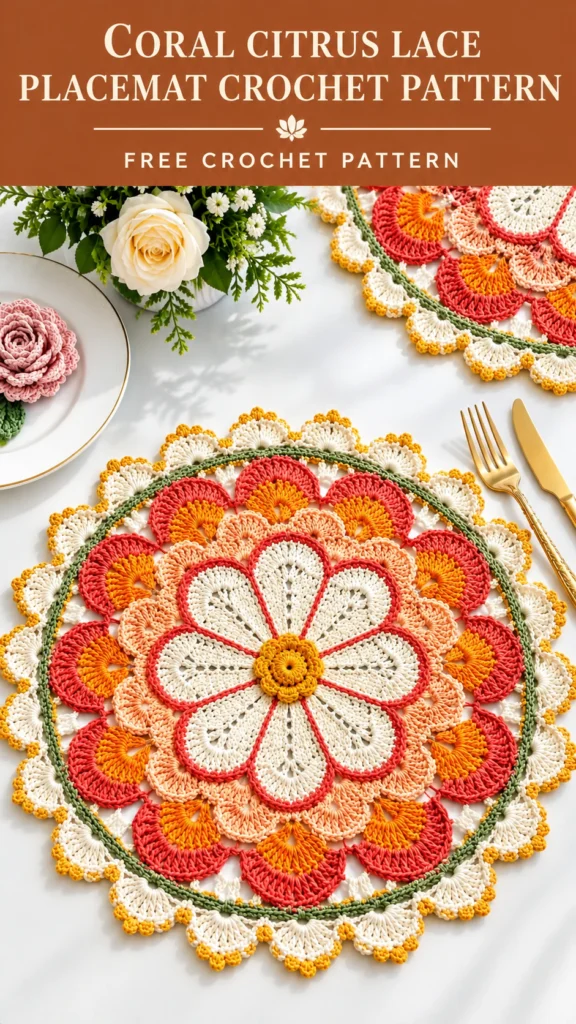
You Might Also Like
- Classic Cream Highland Cow Amigurumi Free Crochet Pattern
- Teal Fern Corset Top Crochet Pattern
- Cherry Blossom Spring Mermaid Free Crochet Pattern
- Blueberry Couple Amigurumi Free Crochet Pattern
- Icy Blue Winter Frost Bag Free Crochet Pattern
FAQ’s
How long does one placemat take to make?
Most crocheters finish a single placemat in two to four hours. A full set of four takes a relaxed weekend, especially once you memorize the repeat.
Can I use regular worsted weight yarn instead of thread?
Yes, but size up your hook accordingly. Worsted weight with an H or I hook makes chunkier, more casual placemats that work great for everyday use.
How do I keep placemats from sliding on the table?
Block them firmly so they lie perfectly flat. You can also work a few rounds of tight single crochet underneath or add a thin layer of fabric backing.
Are these placemats machine washable?
Cotton thread handles gentle machine washing on cold. Lay them flat to dry — the dryer will shrink and distort the lace.
How many placemats should I make for a set?
Four is standard, six is generous, eight covers a full dinner party. Make them in batches so your tension stays consistent across the set.
What’s the best way to store crochet placemats?
Roll them loosely or stack them flat in a drawer. Never fold them tightly — creases in lace are stubborn and take forever to relax.
Final Thoughts
The Coral Citrus Lace Placemat turns a boring table staple into something guests actually comment on. It works up fast, uses simple stitches, and delivers a polished result that looks far more complicated than it is.
Pick your citrus shades, block them properly, and stack them proudly. Then invite someone over for dinner, because these deserve to be seen.
FYI, once you make one set, everyone you know will want their own. Consider yourself warned.



Leave a Reply
You must be logged in to post a comment.